
For two years I paid $3.99 a month for a new tab extension.
Every time I opened a browser tab I got a beautiful photo, a clock, an inspiring quote, and a weather widget. It was polished. It was fine. It did absolutely nothing for how I actually work.
I kept it because the alternative was a blank tab (or Google Search box), and that felt worse.
A few weeks ago I cancelled it. Then I spent a weekend building something to replace it — and what I built ended up being more interesting than I expected.
Momentum, if you're familiar with it, is genuinely well-designed. The aesthetics are good. The daily quote is harmless. But the more tightly I've built out my personal operating system, the more the gap became obvious. A vault of interconnected files, agents, and workflows. And the new tab had no idea it existed.
The new tab had no idea who I was.
It didn't know what I was working on. It didn't know what my top priorities were today. It couldn't capture a thought and route it somewhere useful. It was a passive aesthetic layer between me and wherever I was actually trying to go.
A system as specific as mine deserved a front door that knew the address.
What MVP Momentum is
MVP Momentum is a Chrome extension that replaces the new tab page. Dark, analog-minimal: large serif clock, an editable focus line, a background that rotates daily. Aesthetically it does what Momentum did.
But underneath it, it's wired into the system I actually use.
Every morning, after I run my morning brief, my top three priorities for the day get written into a daily note in my vault. The extension reads those. Every new tab I open shows me what I decided mattered today — not a quote someone else wrote, but the three things I chose.
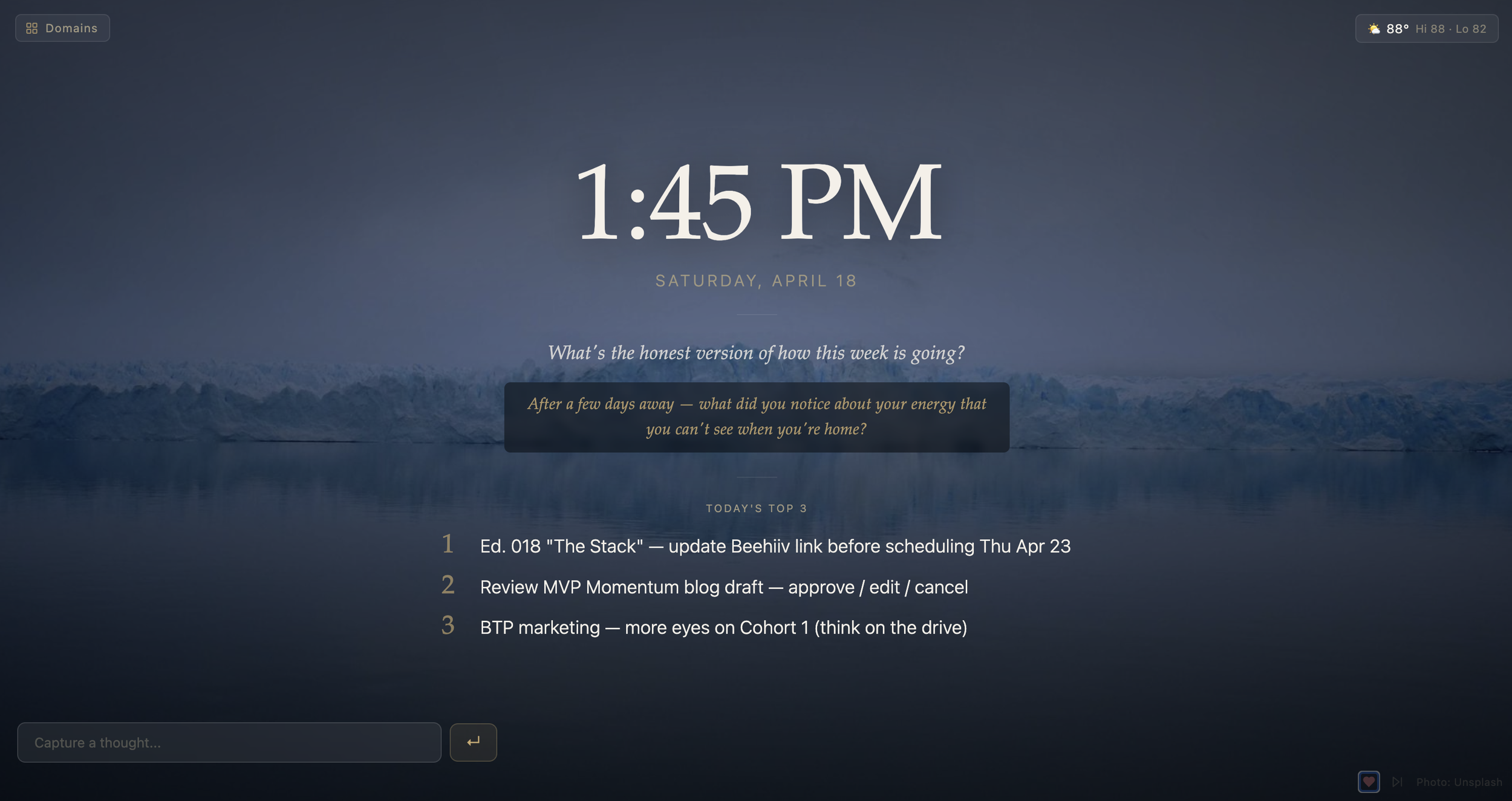
The inbox capture field at the bottom left is always visible. Type a thought, hit enter, it routes directly to my vault as an unprocessed inbox item. Same format, same tags, same flow as everything else I capture. No friction. No switching apps. No "I'll write that down later."
That's it. It doesn't do more than it needs to.
Building it with Claude Code
The actual build took only the better part of an afternoon, working alongside Claude Code.
I want to be specific about what that experience was like, because it wasn't magic. It was iterative. I'd describe what I needed: behavior, not spec. Claude would draft. I'd review, test, catch the edge cases, push back. There were bugs. A background image API that had quietly shut down. A config reference that broke when I reorganized the code. We worked through them the same way you work through any build: read the error, understand the cause, fix it specifically.
What it accelerated was the parts I don't enjoy: the CSS wrestling, the Chrome manifest setup, the storage API boilerplate. Those got done quickly and correctly. I spent my attention on the decisions: what goes in, what stays out, where the integration points should be.
The result is something I understand completely, because I was present for every choice.
What changed & what stayed the same
The most useful thing MVP Momentum does isn't any single feature. It's the forcing function.
When the first thing you see every time you open a browser tab is your own top three. Not a quote, not a placeholder, your actual chosen priorities. It creates a small moment of reorientation, dozens of times a day. You're going somewhere specific. This is why.
The inbox capture changed how I handle stray thoughts. Instead of a note-to-self that lives in a silo, every capture lands in the same system that processes everything else. Not a better version of the old behavior. A different behavior entirely.
The extension costs nothing to run. I own every line of it. And what I have now is shaped to how I work, not just a better browser tab design.
That felt worth an afternoon. What else can I replace that I pay for?
MVP Momentum is a personal project, part of the broader personal OS I've been building and writing about. If you're curious about the system it connects to, the newsletter is the best place to start: thedropin.beehiiv.com
That intentional design — building for how you actually think, not for the average user — is the whole premise of Beyond the Prompt. Cohort 1 starts May 12. Five spots left.